

Our Tampa Limo Blog
How Do You Streamline Employee Airport Transfers?
Quick Summary
Streamline employee airport transfers by writing a clear corporate transportation policy, mapping recurring travel patterns, and scheduling standing car service for fixed rides. Automating flight-status updates and traveler messages then removes most phone calls and last-minute premium bookings.
- Write a policy with eligibility rules, an exception path, and a duty-of-care section.
- Sort travel rides into fixed recurring, event-driven, and one-off groups using six months of data.
- Schedule arrival pickups 30 to 45 minutes after the scheduled landing time.
- Tie pickups to flight-status events rather than fixed clock times.
- Review standing schedules monthly and remove rides for employees who no longer travel.
Table of Contents
- Why Employee Airport Transfers Create Hidden Costs
- Start With a Written Corporate Transportation Policy
- Map Your Recurring Travel Patterns
- How to Schedule Recurring Corporate Car Service
- Build a Booking Workflow Your Assistants Can Run
- Managing Employee Travel Logistics During Flight Delays and Changes
- Your Next Step: Set Up Your First Recurring Pickup
- Frequently Asked Questions
Why Employee Airport Transfers Create Hidden Costs
Last Updated: November 4, 2026
Employee airport transfers look simple on paper: a driver, a pickup time, and a drop-off. In practice, they quietly drain budgets and eat up hours.
The hidden costs usually fall into four buckets: administrative time, last-minute premium bookings, missed or duplicated rides, and expense report friction. Each one is small on its own. Together they add up fast, especially for teams flying in and out of Tampa International Airport several times a month.
Start With a Written Corporate Transportation Policy
A written policy is the foundation for any efficient program, but most published policies are one-page lists of questions that nobody enforces. The version that actually controls cost has three parts: eligibility rules, an approval and exception mechanism, and a duty-of-care clause that defines the employer's responsibility for employee transit. Many published policies cover only the first part.
Part 1: Eligibility and vehicle rules
Answer these in plain language so an assistant can apply them without asking:
- Who qualifies for a car service instead of rideshare or a company vehicle? Common triggers are arrivals after a set hour, travel with heavy or sensitive luggage, client-facing trips, and employees traveling in groups of three or more.
- Which vehicle class is standard for one traveler versus a small group, and what is the cap on the vehicle class an assistant may book without approval?
- How far in advance must bookings be made, and what is the cutoff for changes and cancellations?
- How are costs coded, by cost center, project, or traveler, so the receipt matches the expense report on the first pass?
Keep this part to one page. A short document that everyone follows beats a long manual that nobody reads.
Part 2: Approval and exception routing
A policy without an exception path gets bypassed. Define who can approve an out-of-policy ride, how fast they must respond, and what happens if they do not respond in time.
Watch out: if the exception path requires a phone call to a manager who is asleep in another time zone, employees will book the ride and argue about it later. That is how out-of-policy spend becomes normal spend.
Part 3: Duty of care and safety protocols
The policy should state, in writing, what the employer owes the employee in transit. A duty-of-care section is often overlooked, yet it matters most when something goes wrong. At minimum, address:
- Driver vetting: require that the provider confirm background checks, valid licensing, and insurance coverage for every assigned driver, and produce that documentation on request.
- Vehicle standards: set a minimum vehicle age, maintenance schedule, and insurance limit that your provider must meet.
- Late-night and solo travel: define a check-in protocol, for example, the traveler confirms arrival by message, and the coordinator follows up if confirmation does not arrive within a set window.
- Incident reporting: name who the traveler calls first, what the provider must report to you and within what timeframe, and who reviews the incident afterward.
- Data handling: confirm how the provider stores traveler names, flight numbers, and pickup addresses, and that it will not share that data outside the engagement.
These are not legal advice, and the specifics depend on your organization's risk posture and any applicable state or federal requirements. The point is that the policy should name the obligations rather than leave them to the provider's standard terms.
Part 4: Make the policy enforceable
A policy only works if the booking system enforces it. Configure the booking channel so that in-policy rides are approved automatically, out-of-policy rides route to the named approver, and every ride carries the cost code from the policy.
Share the policy with employees, executive assistants, and finance at the same time, and date it. A policy with a revision date is easier to update than one that lives in an email thread.
Map Your Recurring Travel Patterns
Most employee airport transfers are not random. They repeat: the same executives flying in on Monday mornings, the same sales team leaving Thursday evenings, the same client visits each quarter.
Pull the last six months of travel data from your expense system or booking records. Then sort rides into three groups:
- Fixed recurring rides on the same weekday and time each week.
- Event-driven rides tied to conferences, board meetings, or client visits.
- One-off rides that do not repeat.
Fixed recurring rides are the ones to automate first. They account for most of the administrative workload, and they are the easiest to book in advance at predictable rates.
The article sorts travel rides into three groups, which makes the fixed recurring ones the first to automate.
| Ride type | Description | Priority |
|---|---|---|
| Fixed recurring | Same weekday and time each week | Automate first |
| Event-driven | Tied to conferences, board meetings, or client visits | Group into block bookings |
| One-off | Does not repeat | Handle case by case |
How to Schedule Recurring Corporate Car Service
Scheduling recurring car service is where most of the efficiency gains come from. Set up standing reservations for the fixed recurring group, then review them monthly.
Follow these steps:
Book our black car service now! →
- Export your fixed recurring list. Include traveler name, flight number, pickup or drop-off time, and the terminal.
- Confirm the flight schedule for each standing ride. Airline schedules change, so verify before you lock in a time.
- Set the pickup buffer. A common approach is to schedule arrival pickups 30 to 45 minutes after the scheduled landing time to allow for deplaning and baggage claim.
- Assign a single contact on the transportation provider side and a single owner on your side.
- Review the schedule monthly. Remove rides for employees who no longer travel and add new hires as they start.
Ask your provider whether recurring bookings can be edited without a phone call. Changes handled through an online portal or a standing account save coordinators time every week.
Build a Booking Workflow Your Assistants Can Run
Your executive assistants and travel coordinators should be able to book routine rides without repeated phone calls. A clear workflow lets them book, change, and confirm transfers in a few minutes.
A simple workflow has four stages:
- Request: The traveler or assistant submits the flight details through a single form or booking channel.
- Approve: A manager or policy rule approves rides that fall outside the standard category.
- Confirm: The assistant receives written confirmation with the driver's contact details and vehicle type.
- Reconcile: The ride is matched to the expense report using the cost code from your policy.
Write the workflow down as a checklist that an assistant can follow without training. Include the booking deadline, the cancellation window, and who to contact if a flight changes.
Managing Employee Travel Logistics During Flight Delays and Changes
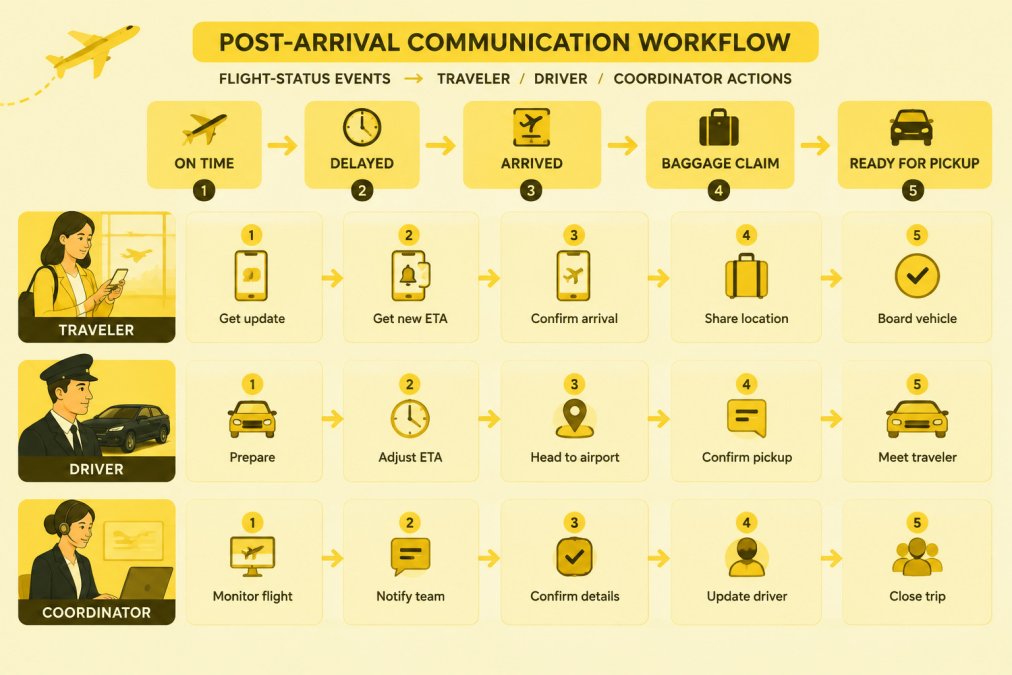
Tracking the flight alone often fails when a flight is delayed, diverted to another airport, or lands early with no gate assigned. The real work is a post-arrival communication workflow that keeps the traveler, the driver, and the coordinator on the same timeline without a single phone call. This part of airport transfer management is easy to overlook, and it is where avoidable spend and traveler frustration often start.
Build the workflow around flight-status events, not clock times
A recurring pickup should never be tied to a fixed clock time. Tie it to a flight-status event. Most airline and airport data feeds publish the same event types, and your workflow should have a defined action for each:
- Scheduled: the standing booking is confirmed; no action.
- Estimated departure or arrival change: the system recalculates the pickup time using your buffer rule and notifies the driver and the traveler.
- Gate change: the pickup point may move between terminals; the traveler receives the new meeting point and the driver receives the new curbside zone.
- Diverted or canceled: the booking is placed on hold, not canceled, so it can be reattached to a rebooked flight without a new reservation fee.
- Landed: the driver is released to the pickup zone and the traveler receives a "your driver is here" message with the vehicle description and plate.
Map each event to an owner. The coordinator owns schedule changes; the provider's dispatch owns driver release; the traveler owns nothing except responding to the meeting-point message. When an event has no owner, it becomes a phone call, and phone calls are where the cost hides.
Set explicit timing thresholds
Vague buffers cause both curbside waits and missed pickups. Publish the thresholds in the policy so everyone applies the same rule:
When comparing providers, ask which clock wait charges run on before you sign.
Automate the traveler-facing messages
The traveler should never have to call to find out what is happening. A three-message sequence covers most disruptions:
- Pre-departure (24 hours out): confirmation with pickup time, driver or vehicle details if assigned, and a single escalation number.
- On landing: a message with the meeting point, the vehicle description and plate, and a one-tap option to report a problem.
- On delay or diversion: an automatic message stating the new pickup time and confirming the driver has been notified, so the traveler is not left guessing whether anyone knows.
Keep every message short enough to read on a phone at a baggage carousel. Long policy language belongs in the policy document, not in a text message at midnight.
Give the traveler one escalation path
A single number or in-app button that reaches a human who can rebook, extend a wait, or dispatch a replacement vehicle is worth more than any dashboard. Route it to a person, not a general inbox. Track how often it is used and why, the pattern of escalations tells you which flight routes, terminals, or providers need attention next quarter.
Review disruptions monthly, not annually
Pull the delay and change log each month and sort it by cause: airline schedule change, weather, gate change, traveler no-show, or provider failure. The first three are outside your control but can be buffered; the last two are process problems you can fix.
Your Next Step: Set Up Your First Recurring Pickup
Start with one route. Choose a fixed recurring ride, such as a weekly executive arrival, and move it into a standing booking this week. Once that runs smoothly for a month, add the next group.
For questions about recurring service, group capacity, or current rates, contact Prestige Black Car Service directly for a quote tailored to your schedule.
Frequently Asked Questions
How do you ensure punctuality for employee airport transfers?
Ask your car service how it tracks flights and what its procedure is when a flight is delayed or diverted, and give the provider the traveler's mobile number so the driver can reach them directly. Build a buffer between landing and pickup for baggage claim. Prestige Black Car Service can explain its own scheduling and tracking process; check its website or request a quote for current details.
What should be included in a corporate transportation policy?
A useful policy names who may book car service, which trip types qualify (airport transfers, client meetings, late-night travel), how bookings are made, and who approves them. It should also cover vehicle class standards, how changes and cancellations are handled, and how receipts are submitted for expense reporting. Include a clear rule for when ride-sharing is acceptable instead of private transport, and review the policy each year as travel volume changes. Written rules make it easier for assistants and travelers to book correctly without asking for approval each time.
Is it more cost-effective to use ride-sharing or private car services for business?
The answer depends on trip volume, timing, and the traveler's needs. Ride-sharing can work for single, low-stakes trips, but availability and wait times vary, and it offers less control over vehicle condition and arrival timing. Private car service often costs more per trip but provides guaranteed pickups, a consistent standard, and simpler billing for recurring transfers. Compare the total cost, including the time spent by assistants arranging trips, before deciding. Current rates depend on vehicle, distance, and schedule, so request a quote from Prestige Black Car Service for your specific routes.

‹ Back
Recent Posts
-

How to Book Wedding Transportation for Guests, Step by Step
November 10, 2026
-

How to Find a Car Service Quickly When You Need One
November 9, 2026
-

Can You Prebook Tampa Airport Transportation for Late Flights?
November 9, 2026
-

How to Manage Executive Travel Logistics in 2026
November 8, 2026
-

How to Schedule Recurring Airport Pickups Step by Step
November 7, 2026