

Our Tampa Limo Blog
5 Best Practices for Business Roadshow Planning
Quick Summary
Effective roadshow planning starts with logistics, not the pitch. Set a clear objective, audience and success metric for each stop, sequence the route around travel time, assign a per-city budget, keep one master timeline, and plan transportation and contingencies. Most roadshows fail on travel delays before the message ever gets tested.
- Write an objective, audience and success metric for every stop before travel begins.
- Place high-risk travel legs early in the trip so there is time to recover.
- Use the same budget template for every city so overruns are easy to spot.
- Name one owner for the master timeline and share the full itinerary with all travelers.
- Book backup transportation for high-stakes legs and track results after each stop.
Table of Contents
- Why Roadshows Fail on Logistics Before They Fail on Message
- Practice 1: Define Objectives, Audience and Success Metrics for Every Stop
- Practice 2: Optimize Route Sequencing and Set a Per-City Budget
- Practice 3: Build a Master Timeline and Planning Checklist
- Practice 4: Plan Corporate Event Transportation and Travel Coordination
- Practice 5: Plan Contingencies, Measure Results and Iterate Between Stops
- Book Your Roadshow Transportation Before the Calendar Fills
- Frequently Asked Questions
Why Roadshows Fail on Logistics Before They Fail on Message
Last Updated: November 11, 2026
A roadshow is only as strong as its weakest travel leg, and sound roadshow planning starts with the transportation that connects every stop. Most teams spend weeks polishing the pitch and days, if that, planning how executives get from one city to the next.
Most roadshow problems start with logistics. When travel runs late, meetings start late, investor attention drops and the team rushes the final slides. Plan the moving parts first, then polish the message.
- Late arrivals cut short the most valuable meetings.
- Missed flights push the team into a second day in the wrong city.
- Scattered ground transport drains time that should go to preparation.
Practice 1: Define Objectives, Audience and Success Metrics for Every Stop
Each stop needs its own goal. A meeting with a pension fund in one city may matter more than a broad presentation in another. Write down what you want from each stop, who you need to reach and how you will judge success.
A simple stop brief works well:
- Objective: What must happen at this stop (for example, two follow-up meetings booked)
- Audience: The decision makers and influencers in the room
- Success metric: The number that tells you the stop worked (meetings booked, commitments received)
Teams often skip this step and then argue afterward about whether a stop went well. Settle the question before the trip starts.
Practice 2: Optimize Route Sequencing and Set a Per-City Budget
Route order and budget decide how much of each day is usable. Both deserve planning before anyone books a flight, and most general event guides treat them as afterthoughts. A roadshow is different because the same team moves through several markets in sequence, so a small timing error repeats at every stop.
Sequencing Stops Around Travel Time and Demand
Start by listing every stop with its planned meeting window, then map the drive or flight time between each pair of cities. Two questions shape the order: Compare the cost of a corporate car service contract before you commit to one for your route.
- Travel friction: Which legs carry the highest risk of delay, such as a connecting flight, a drive through a congested metro, or a route that crosses a mountain pass in winter? Place those legs early in the trip, when there is still time to recover, rather than at the end, when a missed connection can cancel the final meeting.
- Audience availability: Some investors and corporate buyers are easier to reach on certain days. Check whether each host has a fixed calendar pattern, such as a monthly investment committee or a weekly procurement review, and build the route around those windows.
A practical method is to draft two or three candidate sequences and score each one on total travel hours, number of overnight stays, and the count of high-priority stops that fall in the first half of the trip. The sequence with the fewest overnights and the most important meetings early usually wins. Keep the arithmetic visible to the whole team so the choice can be defended later.
Watch out: a route that looks efficient on a map can fail in practice if it ignores time-of-day traffic, so test the critical drives at the same hour as the scheduled meeting.
A Repeatable Per-City Budget Model
Assign each city its own budget with the same line items, so costs can be compared across stops. A workable structure includes:
- Venue or meeting space: Room rental, setup, and any required audiovisual equipment
- Ground transportation: Airport transfers, intercity drives, and daily point-to-point trips for the team
- Lodging and meals: Hotel nights and a per-person daily allowance
- Staffing: Local hires, such as a greeter, a note-taker, or extra support for a large event
- Materials and equipment: Printing, sample shipping, and any demonstration hardware
- Contingency reserve: A fixed percentage held back for changes
Use the same template for every city, then adjust only the local variables. This makes it easy to see which stop is running over and why.
A common pattern is to set the contingency reserve at a fixed share of each city's total, then release it only for documented changes.
The article lists the budget line items every city should use, so the same template can be compared across stops.
| Budget line item | What it covers | Note |
|---|---|---|
| Venue or meeting space | Room rental, setup, audiovisual equipment | Same template for every city |
| Ground transportation | Airport transfers, intercity drives, daily trips | Track against the route plan |
| Lodging and meals | Hotel nights, per-person daily allowance | Set per stop |
| Staffing | Local greeter, note-taker, extra support | Hire for large events |
| Materials and equipment | Printing, sample shipping, demo hardware | Check before each stop |
| Contingency reserve | Fixed share held back for changes | Release only for documented changes |
Practice 3: Build a Master Timeline and Planning Checklist
A master timeline keeps every team member working from the same plan. Start with fixed points such as flights, hotel check-ins and meeting times. Then add preparation tasks working backward from each event.
Use a checklist with clear owners:
- Confirm all meeting times with each host
- Share the full itinerary with every traveler
- Book ground transportation for each leg
- Send materials and decks at least 48 hours before each stop
- Assign one person to handle schedule changes
Name a single owner for the timeline. When everyone can see the same plan, last-minute surprises drop sharply. Read our broader guide to managing executive travel logistics for more planning steps.
Practice 4: Plan Corporate Event Transportation and Travel Coordination
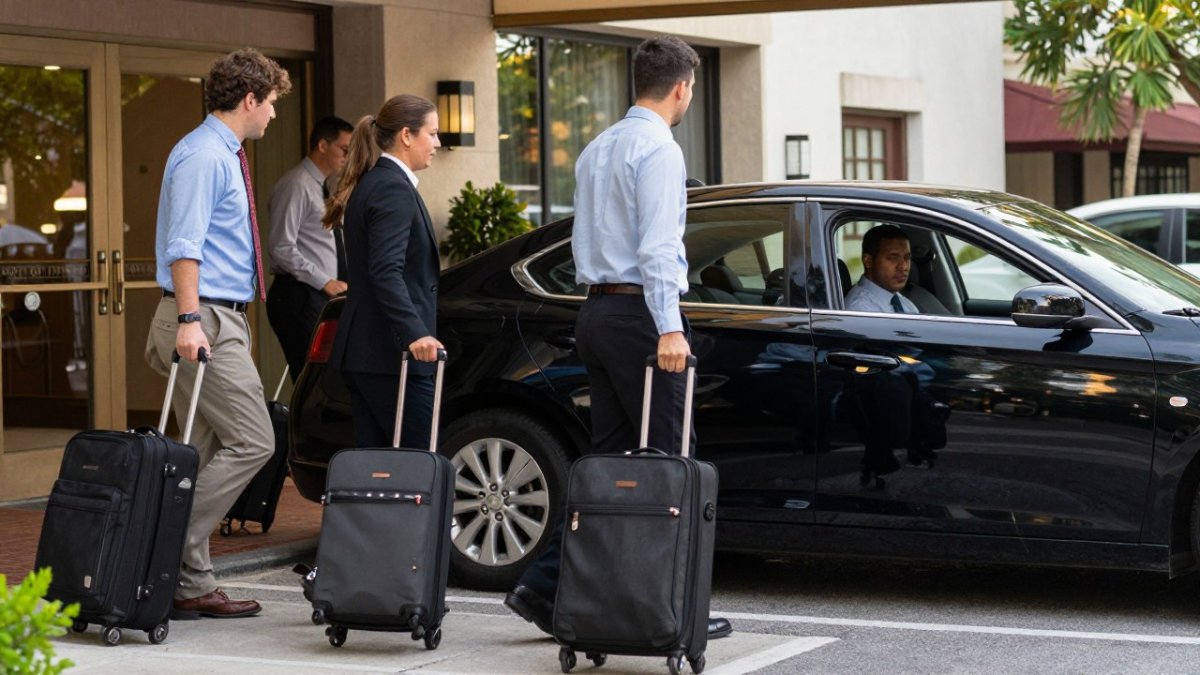
Ground transportation is where roadshows often lose time. Executives need to arrive on schedule, look prepared and reach the next stop without stress. Coordinate pickups, drop-offs and vehicle capacity before the trip, not the morning of.
Consider these points:
- Confirm group size early. A team of six may need one vehicle, while a larger group needs multiple.
- Plan luggage space for every leg, including sample cases and presentation materials.
- Share pickup times and addresses with the driver and the whole team.
- Keep one contact number for the group so changes reach the right person quickly.
For a deeper look at how private car service fits into event travel, see our planning guide on private car service for corporate events. Teams coordinating travel for a multi-stop trip can also review how black car services simplify event logistics in Tampa.
Practice 5: Plan Contingencies, Measure Results and Iterate Between Stops
No roadshow runs perfectly, and the cost of a problem grows with each stop that follows it. A delayed flight in the first city can push the second city's meetings into the evening, and a failed vehicle booking in the third can cascade through the rest of the tour. Planning for disruption across the whole route is what separates a tour that recovers from one that unravels.
Build Contingency Plans for Each Failure Type
Sort likely failures into categories and assign a specific response to each:
- Travel delay: Keep a second flight option for the most critical legs, and confirm that the ground driver knows the alternate pickup point. If a delay makes a meeting impossible, call the host before the scheduled time rather than after it.
- Canceled or rescheduled meeting: Hold one flexible afternoon slot in each city where possible, and keep a list of two or three alternate prospects in the same market who could fill it.
- Equipment failure: Carry a backup laptop, a spare adapter, and printed copies of the core deck. Store a cloud copy of every file in a location the whole team can reach from a phone.
- Vehicle or driver no-show: Book a backup provider for each high-stakes leg and share both confirmation numbers with the traveling team.
- Schedule compression: When a day falls behind, decide in advance which stop to drop or shorten. Teams that make that call early keep the most valuable meetings intact.
Watch out: contingency plans that exist only in one person's head fail under pressure, so write the response for each failure type into the shared timeline with a named owner.
Measure Each Stop Against Specific KPIs
Waiting until the end of the tour to judge results hides problems that could have been fixed. Track a short set of measures after every stop:
- Attendance rate: Confirmed attendees divided by invitations sent to that market
- Qualified leads per stop: Prospects who meet the defined buying or investment criteria
- Cost per lead: The stop's total budget divided by qualified leads
- Follow-up conversion: The share of qualified leads that agree to a second meeting, a trial, or a term sheet within a set window
Record these numbers in a single shared sheet with one row per stop, so patterns across cities are visible. A market with strong attendance but weak conversion may need a different message, while a market with low attendance may need a different invitation channel or day of the week.
Iterate Between Stops
Review each stop within 24 hours while details are fresh. Ask three questions: what was said that the pitch did not anticipate, which logistics slowed the team down, and what should change before the next city. Apply the changes to the next stop's plan the same week. Teams that run this short review loop tend to tighten both their route and their message as the tour progresses, which is the main reason a repeatable process beats a one-time plan.
Book Your Roadshow Transportation Before the Calendar Fills
Reliable transportation is the quiet foundation of a successful roadshow. Book our black car service now to lock in your roadshow transportation before your calendar fills. See the corporate car services we offer for business travel in Tampa.
BUTTON: Book Your Roadshow Transport CARD_TITLE: Need reliable roadshow transportation? CARD_TEXT: Prestige Black Car Service provides punctual drivers and well-maintained vehicles for multi-city business travel.
Frequently Asked Questions
How far in advance should you plan a business roadshow?
Most roadshows need six to ten weeks of lead time for venue holds, speaker confirmations, attendee invitations and travel bookings. Larger multi-city tours, or tours that depend on partner venues, benefit from starting three to four months out. Work backward from the first stop, and set a fixed date for the final itinerary so transportation and hotel blocks can be confirmed before rates and availability shift.
What should be included in a roadshow itinerary?
A useful itinerary lists each stop with its date, arrival and departure times, venue address, contact person, and the ground transportation for each leg. Add buffer time between meetings, the hotel for each night, and a backup plan for weather or flight delays. Include the planned attendance and the metrics you will capture at each stop so the team can compare results afterward.
How do you coordinate transportation for a multi-city business roadshow?
Start by mapping every airport arrival, venue transfer and departure, then group them by day. Book recurring or grouped pickups through one point of contact, confirm headcount and luggage for each leg, and share the driver details and pickup windows with the whole team. Scheduling transfers at least a few days ahead, and confirming them again the day before, prevents most last-minute gaps.
Can a car service handle a group of about 15 people for a corporate event?
Group transportation for a team of around 15 is usually handled with a larger vehicle such as a sprinter van or a limousine, or with several vehicles dispatched together. Share your headcount, luggage needs and timing with the provider when you request a quote so they can recommend the right fleet mix. Pricing depends on vehicle type, hours and distance, so request a current quote from Prestige Black Car Service directly.

‹ Back
Recent Posts
-
5 Best Practices for Business Roadshow Planning
November 12, 2026
-

What Are the Benefits of Private Airport Transfers?
November 11, 2026
-

How to Book Wedding Transportation for Guests, Step by Step
November 10, 2026
-

How to Find a Car Service Quickly When You Need One
November 9, 2026
-
Can You Prebook Tampa Airport Transportation for Late Flights?
November 9, 2026