

Our Tampa Limo Blog
How to Coordinate Wedding Guest Shuttles in Tampa
Quick Summary
To coordinate wedding guest shuttle services in Tampa, first confirm a firm headcount by hotel and event, then choose vehicle type and accessibility needs. Plan a few fixed pickup points, build a timed schedule with buffers, and send clear RSVP and reminder messages to guests.
- Sort guests by hotel and by which events they attend before contacting any provider.
- Add a buffer of about 10 percent to your headcount for last-minute plus-ones.
- Build at least 15 minutes of front-end buffer for legs that end at the ceremony.
- Leave at least 20 minutes between one trip's arrival and the next pickup.
- Send at least two reminders, one about two weeks before and one three to four days before.
Table of Contents
- When a Wedding Guest Shuttle Makes Sense
- Estimating Headcount and Building a Booking Worksheet
- Choosing Vehicle Type, Capacity, and Accessibility Needs
- Planning Routes and Pickup Locations Between Hotels and Venues
- Building a Wedding Shuttle Schedule Template
- Sending Guest Transportation RSVP Wording and Reminders
- Setting a Budget, Comparing Shuttle Costs, and Booking Your Provider
- Frequently Asked Questions
When a Wedding Guest Shuttle Makes Sense
Last Updated: November 13, 2026
Most wedding guests want the same thing: a fun night out without worrying about parking, rideshare surges, or a long walk home in heels. A wedding guest shuttle solves all of that. We help couples and planners put guests on a shared vehicle that moves the whole group at once.
A shuttle makes sense when several guests travel between the same few points. Think hotel to ceremony, ceremony to reception, and reception back to the hotel.
Shuttles also make sense when timing matters. Guests who all need to arrive at the ceremony by a set time are far less likely to be late when one vehicle is picking them up on a fixed schedule.
Consider a shuttle when:
- Guests are staying in one or two hotels near the venue
- The ceremony and reception are at different locations
- The venue has limited parking or a strict arrival window
- Older relatives or guests with mobility needs will be attending
- The wedding party needs to arrive together
A shuttle may not be the right call for a small, local wedding where guests live nearby. In that case, a few rideshare trips or a designated driver plan may be simpler.
Estimating Headcount and Building a Booking Worksheet
Before you contact a provider, you need a clear headcount. Guess too low and you will be stuck with extra rides on the day. Guess too high and you pay for empty seats.
Start with your guest list and sort people by where they are staying. Then sort again by which events they plan to attend. A guest who skips the rehearsal dinner does not need a rehearsal dinner pickup.
A simple worksheet helps. Use a spreadsheet with these columns:
- Guest name or party name
- Hotel or home address
- Events attending (ceremony, reception, after-party)
- Number of people in the party
- Accessibility needs
- Pickup time and return time
Add up the totals for each leg of the trip. That number tells you how many seats you need at each pickup point.
Build in a buffer of about 10 percent. Last-minute plus-ones and family members who decide to come are common. Tell your provider your buffer number up front so they can plan vehicle size.
Many planners find it useful to send a short survey through the wedding website. Ask guests to confirm their travel plans by a set date. This gives you accurate numbers without chasing people down.
Choosing Vehicle Type, Capacity, and Accessibility Needs
Vehicle choice depends on group size, route length, and comfort needs. A large group needs a larger vehicle. A small group may want something more private.
Common choices include:
- Sprinter vans: Good for groups of about 10 to 14 guests, with room for luggage
- Party buses: Fun for after-parties and guests who want a lively ride
- Limousines and luxury sedans: Ideal for wedding parties or small family groups
Always ask the provider how many seats are usable. Some vehicles list a total capacity that leaves little room for bags or wheelchairs.
Accessibility matters. Ask the provider about wheelchair access and how the driver can help guests board safely. Note any guests who need extra time or help getting in and out. Share these details in writing with the provider before the event.
Inclusive planning also means thinking about guests who may feel nervous riding with strangers. Let them know who the driver is and how to contact a coordinator if they need help.
Planning Routes and Pickup Locations Between Hotels and Venues
Good routes save time and keep guests calm. Map each trip before the wedding weekend. Check the drive time at the same hour the shuttle will run, because Tampa traffic can shift a lot between a Friday afternoon and a Saturday evening.
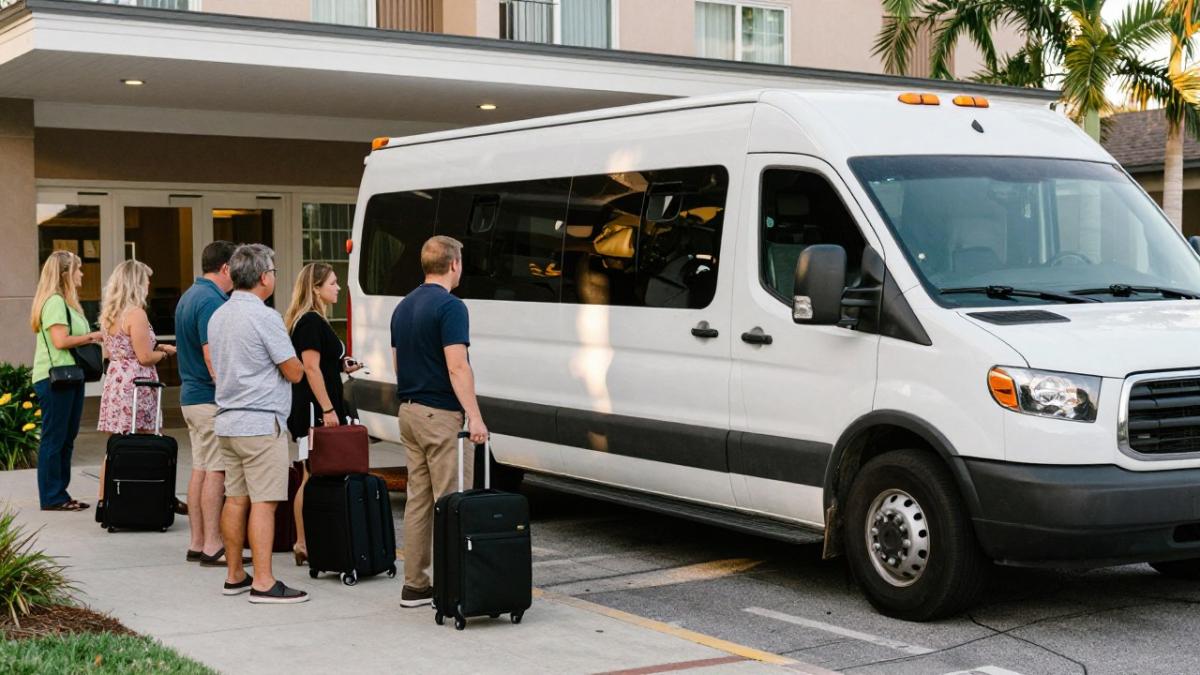
Pick a small number of pickup points. Two or three hotels are easier to manage than eight. If guests are spread out, group them by the closest hotel and ask them to walk or use a short rideshare to the main pickup spot.
Choose pickup locations that are safe, easy to find, and large enough for a vehicle to stop. Hotel entrances often work well because staff can help direct guests. Confirm the spot with the hotel in advance.
Plan for events that could block roads.
Building a Wedding Shuttle Schedule Template
A written schedule keeps everyone on the same page. It also gives your provider what they need to plan drivers and vehicles. The template below is deliberately more detailed than a blank form: it shows a worked example so you can see how buffers, loops, and return trips actually fit together.
Start with the fixed points. The ceremony start time and the reception end time are immovable. Everything else is built backward from those two anchors.
A few mechanics make this schedule work in practice. First, build in a buffer of at least 15 minutes on the front end of any leg that ends at a ceremony. Guests trickle down from hotel rooms, and a 3:30 pickup rarely means everyone is seated at 3:30. Second, treat the reception-to-hotel leg as a loop rather than a single departure. Most couples run two or three return trips so guests who leave early and guests who stay to the last dance both have a ride.
Leave at least 20 minutes between the expected arrival of one trip and the next pickup. This gives drivers time for loading, unloading, and unexpected delays. If a single vehicle is covering multiple hotels, that gap is what keeps the second pickup from sliding into the ceremony start.
Watch out: a schedule that lists only one return departure will strand the guests who want to stay late, and a schedule that lists too many return trips will pay for empty seats. Match the number of return loops to your guest survey results, not to a guess.
Assign one person as the transportation lead. This person should be reachable all day, know the schedule well, and be the single phone number guests call. Give the lead a printed copy and a digital copy, and make sure the provider has the lead's number as well as the couple's.
The schedule template works best when the key timing rules are easy to scan, so here is a summary of the figures the article gives.
| Schedule item | Value from article | Note |
|---|---|---|
| Front-end buffer for ceremony legs | At least 15 minutes | Guests trickle down from hotel rooms |
| Gap before next pickup | At least 20 minutes | Allows loading, unloading and delays |
| Ceremony leg buffer (Leg 1 example) | 15 minutes | Drive time 20 minutes |
| Reception-to-hotel departures (example) | 9:30, 10:30 and 11:15 p.m. | Staggered loop, drive time 20 minutes per loop |
| Day-of contact | One transportation lead | Reachable all day with printed and digital schedule |
Sending Guest Transportation RSVP Wording and Reminders
Clear messages prevent confusion. Put shuttle details on your wedding website and in your invitation follow-up emails. Keep the wording simple.
Here is sample RSVP wording you can adapt:
"We are providing shuttle service between the hotel and the ceremony and reception. Please indicate on your RSVP if you plan to ride. Seats are limited, so please respond by [date]."
Send at least two reminders. One reminder should go out about two weeks before the wedding. A second should go out three to four days before, with the final pickup times and meeting points.
Include these details in every reminder:
- Pickup location and address
- Pickup time
- Name and phone number of the day-of contact
- What to bring (ID, printed copy of the schedule if helpful)
Some couples also include a printed card in the welcome packet at the hotel. This helps guests who do not check email often.
Setting a Budget, Comparing Shuttle Costs, and Booking Your Provider
Pricing depends on vehicle type, hours booked, route length, and the date. Because those variables move together, two quotes for the same wedding can look very different even when the underlying service is similar. The goal is not to find the lowest number; it is to compare quotes on the same terms so the difference is real.
Ask which model each quote uses before you compare totals. A flat rate that includes four hours may be cheaper than an hourly rate with a four-hour minimum plus overtime, or it may not, depending on how many loops you need.
When you request quotes, send every provider the same packet:
- Date and start/end times for each leg
- Pickup and drop-off addresses
- Estimated riders per leg, including your buffer
- Vehicle type requested and any accessibility needs
- Number of return loops planned
- Whether you need a dedicated transportation lead on site
When comparing quotes, check these items line by line:
- Hours included and overtime rate. Confirm what happens if the reception runs 30 minutes long.
- Fuel, tolls, and gratuity. Ask whether these are bundled or added at the end.
- Deposits and payment schedule. Note the deposit amount, when the balance is due, and whether the deposit is refundable.
- Cancellation and change terms. Ask how far out you can reduce hours or change vehicle size without penalty.
- Driver and vehicle details. Request the vehicle make, model, and passenger capacity in writing.
- Backup vehicle plan. Ask what the provider does if the assigned vehicle breaks down.
- Insurance and licensing. Ask the provider to confirm its commercial coverage and passenger vehicle licensing.
Ask every provider to quote the same scope and to state explicitly what is not included.
Book early, especially for Saturdays in peak wedding season. Confirm the contract in writing, including the pickup schedule, vehicle type, overtime rate, and contact person. Once you sign, send the final schedule to your provider and your transportation lead at least two weeks before the wedding. If your guest count changes after signing, notify the provider in writing as soon as possible so vehicle size can be adjusted within the change window.
Frequently Asked Questions
How much does a wedding shuttle usually cost?
Wedding shuttle pricing depends on the vehicle type, the number of hours booked, the distance between pickup and drop-off points, and the dates of your event. Rather than relying on a general estimate, request a written quote that lists the vehicle, hourly or flat rate, driver gratuity, fuel, and any travel fees. Prestige Black Car Service can provide current pricing and a custom quote for your wedding weekend on our website, so you can compare total costs against the number of guests you need to move.
How far in advance should you book a wedding shuttle?
Book your wedding guest shuttle as soon as you have a confirmed venue, a firm date, and a rough headcount, ideally several months ahead of the wedding. Peak wedding dates and weekends in the Tampa area fill quickly, and popular vehicles can be reserved early. Booking early also gives you time to share pickup details with guests through your wedding website and pre-wedding emails.
How many guests can one wedding shuttle transport?
Capacity depends on the vehicle. A standard passenger van or minibus carries a modest group, while a larger shuttle or party bus can seat many more guests at once. Plan for a seat for every guest who needs a ride, and add a buffer for luggage and guests with mobility needs. If your headcount exceeds one vehicle, plan a shuttle loop with staggered pickup times so no guest waits too long.
How should you plan wedding shuttle pickup and return times?
Work backward from the ceremony start time. Add travel time for each route, a traffic buffer that reflects Tampa rush hour and event traffic, and time for guests to board. Schedule the first pickup early enough to get everyone to the ceremony on time, and set return trips for when the reception ends, with a short window for late departures. Share the final schedule with guests and assign a day-of transportation contact to handle changes.

‹ Back
Recent Posts
-

How to Coordinate Wedding Guest Shuttles in Tampa
November 14, 2026
-

Private Car Service Booking Flexibility: A Complete Guide
November 13, 2026
-
5 Best Practices for Business Roadshow Planning
November 12, 2026
-

What Are the Benefits of Private Airport Transfers?
November 11, 2026
-

How to Book Wedding Transportation for Guests, Step by Step
November 10, 2026